Detailed Process of Coarse and Fine Particle Separation in a Hydro Cyclone
 June.23,2026
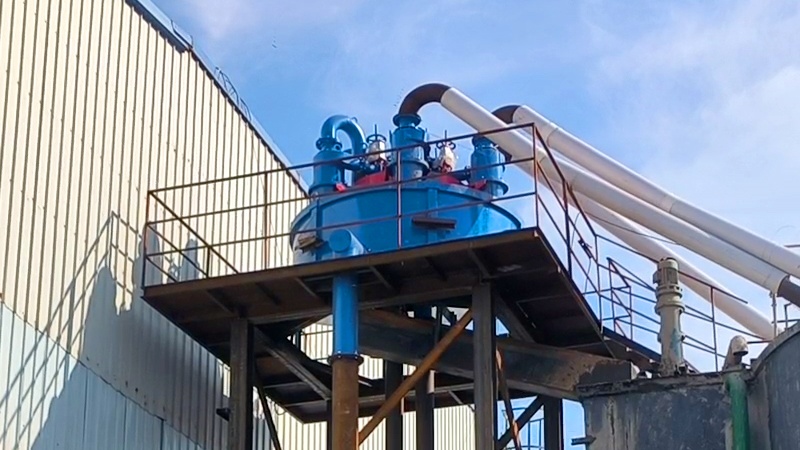
Solid particles enter the cyclone tangentially, suspended within the slurry. Upon striking the vessel wall, the liquid component of the slurry is forced into a rotational motion, whereas the solid particles tend to continue moving forward due to their initial linear momentum. Coarse particles, possessing greater inertia, can overcome hydrodynamic resistance to migrate toward the vessel wall; conversely, fine particles have less inertia and are swept into the rotational flow of the slurry before they can reach the wall. Driven by the continuous inflow of feed, the slurry moves both downward and rotationally, generating inertial centrifugal forces on the solid particles. Consequently, coarse particles concentrate toward the periphery, while fine particles remain in the central region, resulting in a stratification of particles ranging from the wall to the center.
Naturally, inertial centrifugal forces act not only on the solid particles but also on the liquid phase of the slurry; these forces are transmitted layer by layer from the interior outward, reaching a maximum at the vessel wall. The liquid pressure at this point balances the feed pressure—which explains why a specific feed pressure is required for cyclone operation. This tendency toward centrifugal motion prevents the slurry from exiting directly through the overflow pipe upon entry, forcing it instead into a downward rotational path. However, if the feed pressure is insufficient to generate adequate rotational velocity, the slurry may discharge directly through the overflow pipe, rendering particle size classification impossible.
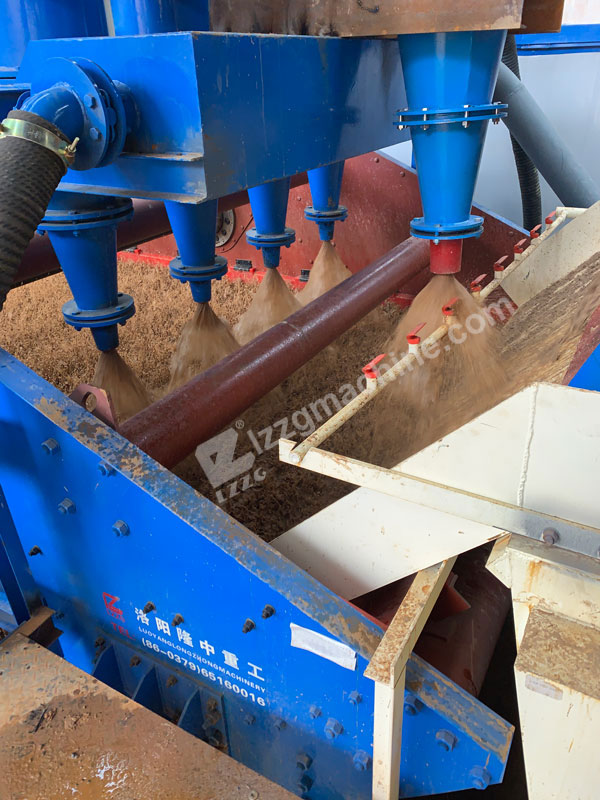
As the slurry flows from the cylindrical section of the cyclone into the conical section, the cross-sectional area of the flow decreases. Compressed by the contracting outer layer of slurry, the inner layer is forced to reverse direction and flow upward. This creates two sets of rotational flows within the cyclone: a downward-moving outer vortex and an upward-moving inner vortex. While their tangential flow directions remain consistent, their axial directions differ. At the point where the flow direction reverses, the velocity is zero. Connecting these points of zero velocity forms an open, cup-shaped curved surface known as the “axial zero-velocity envelope.” Fine particles located within this envelope are carried into the overflow, while coarser particles outside it report to the underflow; thus, the spatial position of this envelope determines the separation particle size. The interlayer pressure within the slurry, generated by the rotation, reaches its minimum along the vertical line beneath the overflow pipe. As the slurry expands centrifugally, liquid is displaced from the central axis, creating a low-pressure air column with an average diameter approximately 0.5 to 0.6 times the inner diameter of the overflow pipe; because the internal pressure is below atmospheric pressure, air is continuously drawn in through the underflow outlet. While it was previously believed that the free liquid surface surrounding the air column helped reduce the mixing of coarse and fine particles, recent research has revealed that the violent oscillation of the air column consumes significant energy and destabilizes the classification particle size; consequently, various measures have been proposed to eliminate this air column.